Why Today's Auditors Can't Afford to Wait
The real case for AI in audit isn't fewer hours. It's what it does to the learning curve, and how fast junior auditors can start exercising judgment.

I started my audit career earlier than most. Thanks to the University of Waterloo's co-op program, I got to experience my first busy season as an auditor years before most of my peers had finished their degrees. At 19 years old, I was a junior auditor at EY Toronto and it felt like a head start.
Looking back, I've realized what that head start was actually made of. It was countless hours spent matching numbers and totals across multiple sources of documentation, manually tying out values, one line at a time. And while every hour of that work was necessary, almost none of it required judgment.
That was ten years ago. Today, a junior auditor doesn't have to spend years on the same repetitive testing and documentation before anyone asks what the finding means. What took me three years to absorb by repetition, they can pick up in months by reviewing work an agent has already done.
That's why AI adoption can fundamentally change what a career in audit looks like.
In short
- I think AI's biggest impact on auditors isn't fewer hours. It's shortening the learning curve to help them build the skills and confidence needed to apply sound judgment sooner.
- That means the biggest opportunity in our profession is becoming the auditor who uses AI to deliver deeper insights.
- Because AI makes testing easier to automate, the differentiator will be knowing what questions to ask, what to look for, and how to interpret the results.
The real case for AI: it compresses the learning curve for new auditors
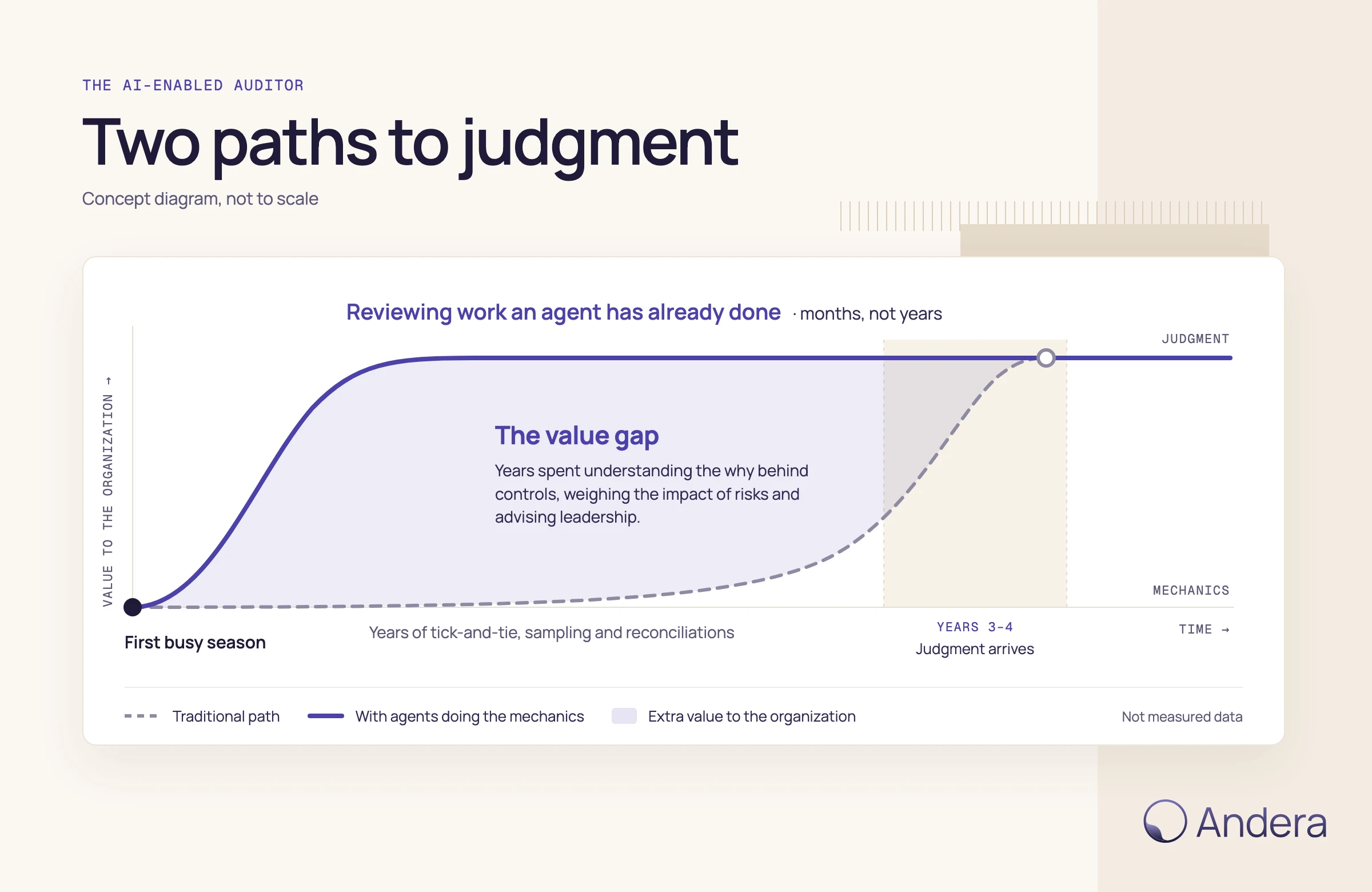 Two paths to judgment. Concept diagram, not to scale.
In a profession that has struggled to attract and keep new talent, an audit career that starts with thinking instead of ticking is a much easier one to sell. According to the AICPA's National Pipeline Advisory Group, accounting degree completions, a key pipeline into audit, fell 17% in just four years, a clear indication that the audit profession needs to rethink how it attracts, develops, and retains the next generation of auditors to stay competitive.
When people talk about AI in audit, the conversation naturally jumps straight to efficiency: fewer hours, lower cost, faster turnaround. While those gains are real and important, they're only part of the story.
AI changes the learning curve in a way earlier technology never could. Spreadsheets, audit software and automation all made the work faster, but none of them changed how fast a junior auditor can start to think like a senior one.
In the traditional model, junior auditors earn the right to exercise judgment only after years of tick-and-tie work, sampling, and testing, work that effectively teaches process. A junior learns the mechanics long before anyone asks them to interpret what they found, and if they're lucky enough, they sometimes get a seat at the table to be able to talk about it.
AI changes that sequence. When routine testing, data gathering, and preparing a reconciliation can be handled in a fraction of the time, a first- or second-year auditor can spend their time understanding the why behind a control, the impact an identified risk may have on the business, and how to communicate that information to leadership to make better, risk-informed decisions. These were the parts of the job that used to be reserved for people three or four years in.
Therefore, the case for AI in audit is just as much a talent development story as it is a productivity story. We can build sharper auditors in a fraction of the time by helping them develop judgment and critical thinking earlier, rather than making them spend years proving they can handle repetitive, mechanical work first.
The art of the possible
Developing judgment this early in an auditor's career wasn't realistic with the tools I started with. Traditional automated audit and control testing tools did what a well-trained macro could do, which is to follow rigid rules someone coded in advance.
AI control testing does something closer to what a first-year associate does, which is read, interpret and connect. In our world, the evidence can be in the form of contracts, emails, meeting minutes or vendor correspondence. Reasoning over this data and running end-to-end testing is a different kind of capability from the automation our profession has used before. This looks like the judgment work we've always said only a trained professional could do.
That leads me to two truths.
First: I think the biggest opportunity in our profession is becoming an auditor who uses AI well. These auditors will move faster while testing more evidence with greater accuracy than those who don't. That gap is already showing up in which assurance firms win work and which internal audit and controls teams can keep pace with growing demands.
Second: Testing is becoming commoditized. Within a few years, an auditor's value won't be measured by how many tests they perform or how many samples they review, because AI can execute testing faster and across more evidence than any human can manually.
What won't be commoditized is the judgment to know what needs testing in the first place and which risks deserve attention.
What that looks like in practice
Anyone who learned the job the way I did will ask a fair question here: if AI does the testing, how does a junior ever learn which risks are real? Tick-and-tie is how I learned what a clean population and a real exception look like. The answer now is in how the agent's work gets reviewed.
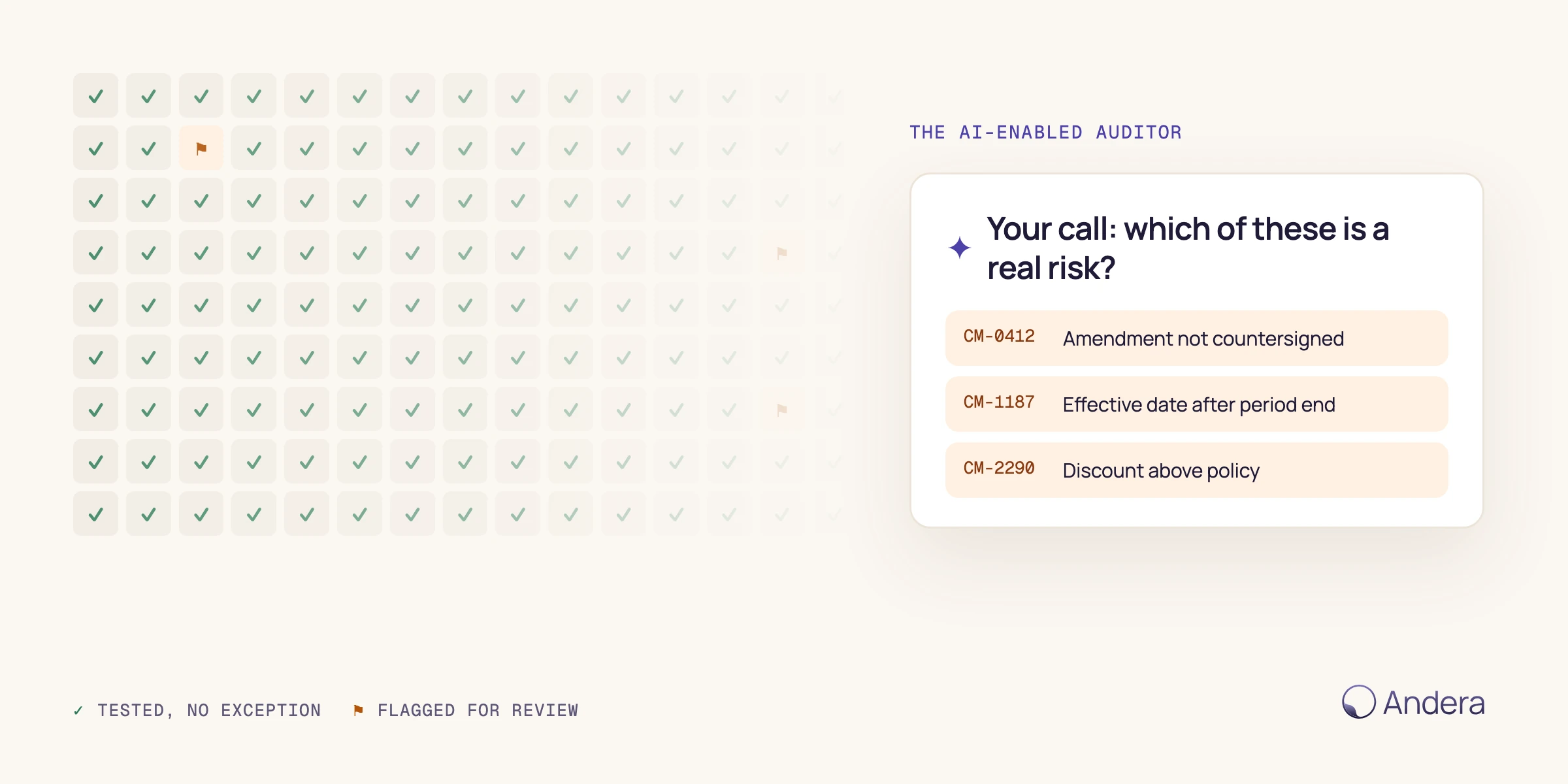
Revenue recognition. The old version of judgment was picking the right sample and keeping the mechanics clean. The new version is where an agent flags twelve unusual contract modifications out of ten thousand. An auditor's value isn't running that scan, because models can do that in their sleep. It's knowing which three of the twelve are real risks and which nine are just noise.
However, a first-year doesn't really start with that instinct. They build that by reviewing the agent's reasoning on all twelve with all the evidence side by side, re-performing anything that seems off and seeing what gets escalated and why.
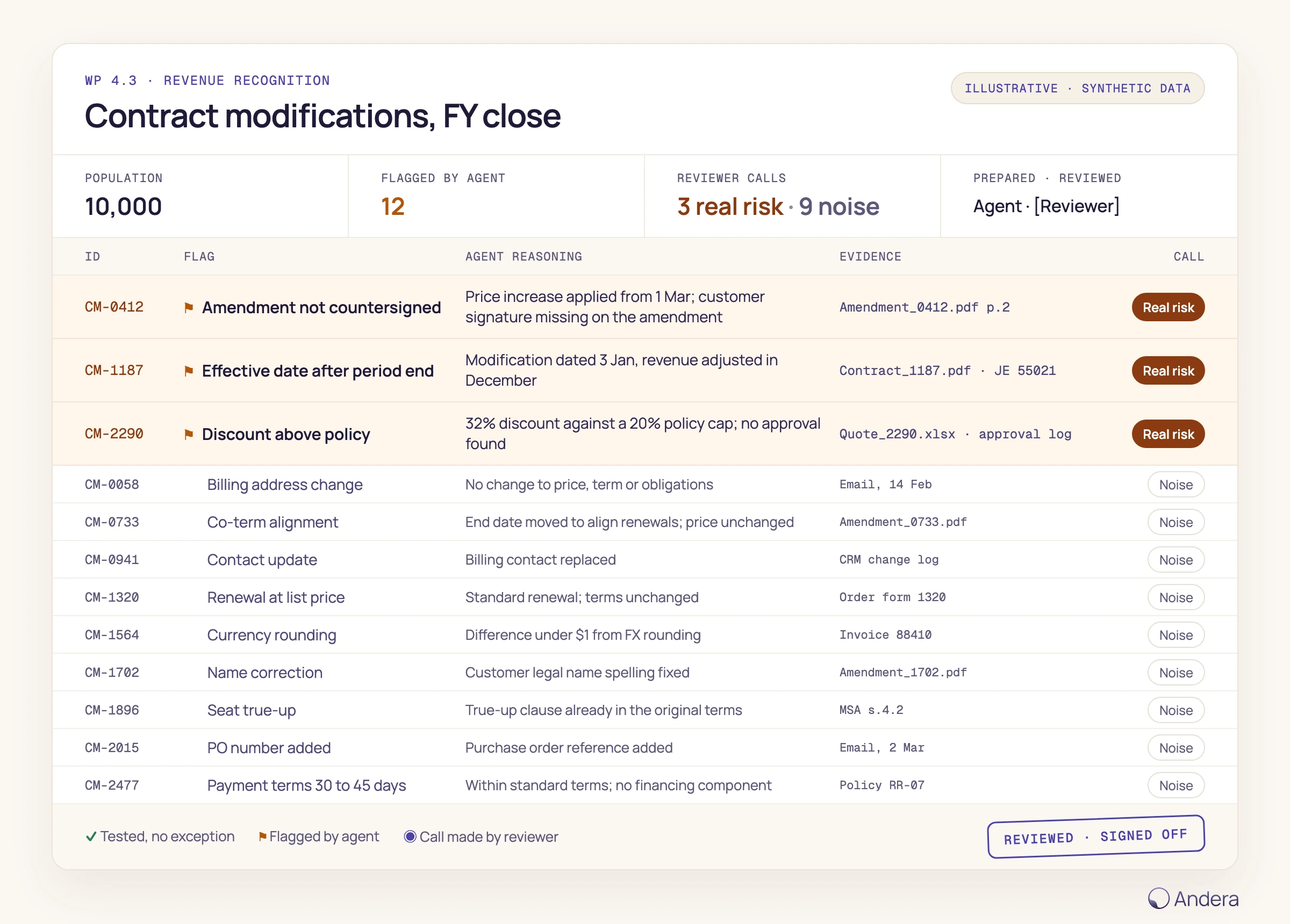 An illustrative agent review: 12 flags out of 10,000 contract modifications, with the reviewer deciding which 3 are real risks.
An expense anomaly. A spike in a vendor category that used to take days to find now surfaces instantly. The job shifts to asking the right question: is it a fraud indicator, or a legitimate change in the business, or is it just due to seasonality?
A junior learns to tell those apart by tracing the spike back to the invoices and asking the business owner why, starting from the agent's analysis instead of a week of pulling data. The key here is being able to reliably trace the steps an agent took to test the controls.
In the room with management. When the heavy lifting on the numbers is done, an auditor can walk in and ask a meaningful question about the intent behind an estimate, instead of spending the meeting gathering facts they could have pulled themselves. Juniors get into those conversations earlier, with the numbers already prepared, and they learn which questions actually move the answer.
In each case, the model does the finding and the auditor makes the call. Review and sign-off stay with people. What changes is how fast auditors develop that instinct, spending their earlier years exercising judgment instead of spending those years on the mechanics of routine testing and documentation.
That's exactly why compressing the learning curve matters. If judgment is about to become the entire differentiator, we need to be building it in people years earlier than we used to.
This doesn't make the human auditor less important, but rather raises the bar on what we're actually valuable for.
Where Andera fits
This is part of why I joined Andera. As the Founding Auditor, I've had a direct hand in building the platform I wish had existed all those years ago: one that uses AI models to take on the repetitive, mechanical work so auditors, especially the newest ones, can spend their time building the judgment that defines a good audit career.
At 19, I learned the job one tie-out at a time. The next generation will learn it by reviewing work an AI agent has already done. The tools have changed, and it's time our expectations changed with them.